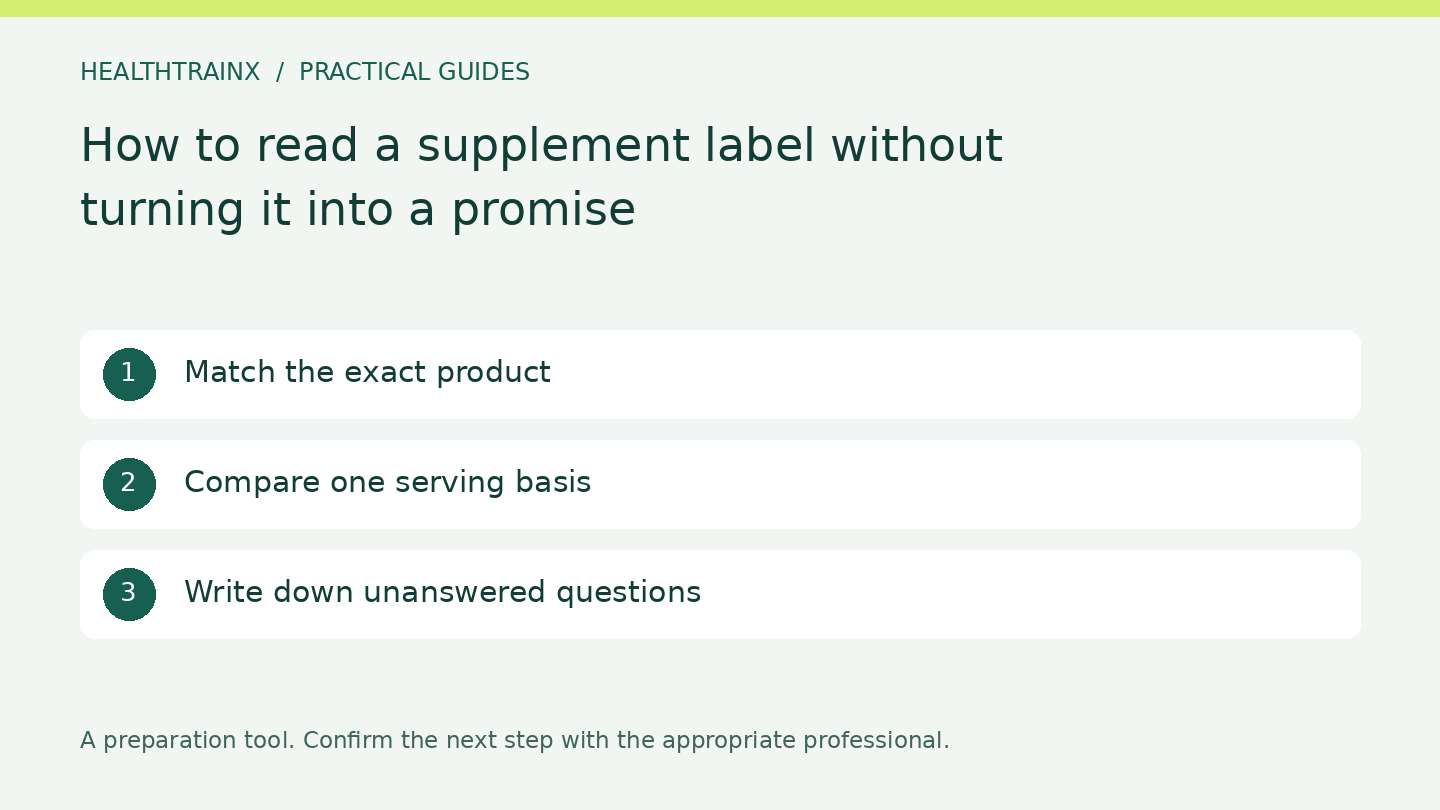
How to read a supplement label without turning it into a promise
By HealthTrainX editorial team · Published October 18, 2026

A supplement label can tell you what a seller says is in a product. It cannot tell you, by itself, whether you need it or whether a benefit claimed online will occur. The most useful first step is to turn the label into a short, consistent record.
Make sure you are comparing the same thing
Record the full name, variant, package size and the date you checked it. A photograph in an old post may show a different formulation or pack. Use a readable current label for the product you would actually order. If the retailer and manufacturer show different information, ask them to reconcile it before treating either as settled.
Start with the serving basis
FDA explains that Supplement Facts panels identify serving size and quantities per serving; other ingredients appear separately. Serving sizes are chosen by manufacturers rather than standardized across all supplements. Compare the same basis and keep the stated units visible. Do not assume that two scoops, two tablets or two similarly sized bottles provide equivalent quantities.
| Field | Your notes |
|---|---|
| Exact product and date checked | _____ |
| Serving size and servings per container | _____ |
| Ingredients and quantities as printed | _____ |
| Other ingredients and warnings | _____ |
| Missing or conflicting information | _____ |
Ready to compare the price as well as the label? Use our total purchase cost worksheet to record the same product, quantity and destination, including delivery and any recurring charges. A lower price does not establish suitability.
Write the question before choosing the product
Consider two fictional shopping notes. “This looks more powerful” is hard to assess. “These labels use different serving sizes; can you help me compare them and decide whether either is relevant to my needs?” gives a pharmacist or clinician a specific question. Include other medicines and supplements in that conversation, rather than assessing a new purchase in isolation.
Keep product identity separate from product claims
A seal, a testimonial and a nutrient amount answer different questions. Write a marketing claim in its own column and look for the evidence behind that particular claim. If a study concerns a different population, dose or formulation, do not assume it applies to the item in your basket. “More” on a label is not a reason to take more.
NIH’s Office of Dietary Supplements explains that multivitamin/mineral products vary, and supplements do not replace a varied diet. Use professional advice for suitability; this worksheet is a shopping and information-organizing aid.
Find provider listings through the partner catalog, where affiliate links may generate commission for HealthTrainX. For a broader question, use the consultation-preparation guide. Related educational material is available in the resource hub.