Category: Blog

  • What Respiratory Symptoms Can and Cannot Tell Us About an Infection

    Skip to content

    What Respiratory Symptoms Can and Cannot Tell Us About an Infection

    HealthTrainX Editorial · Educational guide · Published October 25, 2026

    A cough is information, but it is not the name of an infection. Respiratory symptoms can help someone describe an illness and recognize a reason to seek care. They cannot reliably answer every question about its cause, severity or treatment. Keeping those limits visible is especially important when a website promises a personalized result.

    Similar symptoms can have different causes

    The common cold and influenza are caused by different viruses. Flu often begins more abruptly and feels more intense, while colds are generally milder. There is substantial overlap, so symptoms alone may not distinguish them. CDC explains the differences and overlap.

    Instead of deciding “this must be flu,” write down the actual observation and its timing. That preserves a useful clue without turning a guess into a fact. A result called “phase two,” “high score” or “matched package” is also not a pathogen identification.

    Testing answers a different question

    Antigen tests look for parts of a virus; molecular tests detect genetic material. A negative antigen result can miss an infection. The timing, test instructions and clinical situation matter. Ask a professional about appropriate testing, especially if treatment decisions are time-sensitive. Read CDC’s respiratory testing guidance.

    Record the test name, date and result exactly as given. Separate “not tested,” “negative test” and “infection ruled out by a clinician”; they are not interchangeable labels. Do not paste an app’s confidence score into the test-result field.

    A phase is a description, not a deadline

    People do not all follow one fixed day-by-day course. A useful timeline records whether symptoms changed; it does not promise recovery on a scheduled day. A provider’s phase system needs its own evidence showing what it measures, how accurately it does so and whether the resulting action benefits users.

    Informiton’s audio selection is discussed separately in this series. General respiratory research does not validate that program’s phase assignment, safety screening or audio effects. Improvement after using a tool is not enough to show that the tool caused improvement.

    Why waiting can matter

    CDC advises prompt contact with a healthcare professional for people at increased risk with suspected flu. Risk groups include older adults, pregnant people and people with certain chronic conditions or weakened immunity. See CDC’s full risk guidance.

    Flu antivirals work best when started early, commonly within two days, although later treatment can still help some higher-risk or seriously ill patients. Treatment is a clinical decision. A wellness schedule should never delay that discussion. Read CDC treatment guidance.

    Bring three distinctions to your next conversation

    1. Observed: what happened and when, without a diagnosis added.
    2. Measured: what a device or test actually reported, with its date.
    3. Interpreted: what a qualified professional concluded, or what remains uncertain.

    Use those headings to prepare a short private note. For additional educational resources, visit HealthTrainX practical guides. If you need clinical assessment, contact an appropriate healthcare professional rather than submitting symptoms to a public discussion.

    Our Cold & Flu technology overview separates Informiton’s program description from established respiratory care.

    Disclosure: HealthTrainX’s owner works with Informiton. HealthTrainX also maintains an Informiton referral account. This educational coverage does not establish the program’s clinical effectiveness.

    Sources and scope

    Sources checked October 14, 2026. Provider sources document provider statements, not independent clinical validation.

    CDC source links rechecked October 25, 2026. Educational information; no clinical review or program efficacy validation claimed.
  • A sleep diary that makes your next appointment easier to prepare

    Skip to content

    A sleep diary that makes your next appointment easier to prepare

    By HealthTrainX editorial team

    “I have not been sleeping well” describes a concern, but it leaves much of the practical story unwritten. A dated record can help you explain what you remember, what you estimated and what you want to ask. It cannot identify the cause by itself. This guide offers an original way to organize that conversation without assigning a sleep score or suggesting a treatment.

    Start with a resource you can identify

    The US National Heart, Lung, and Blood Institute provides a free one-page sleep diary. Its description includes sleep quantity and quality, medicines, alcohol, caffeinated drinks and daytime sleepiness. The diary is intended to be brought to a doctor. Use the official form if it suits your needs, and ask your clinician whether another format or recording period would be more useful.

    Add a small confidence column

    Alongside your entry, use three simple labels: remembered, estimated or missing. You might remember when you got out of bed but only estimate when you fell asleep. Keep those differences visible. A precise-looking number is not more useful if you made it up, and a blank marked “not recorded” is clearer than a guessed entry.

    For a fictional example, Sam writes: “Tuesday: bed around 11 p.m., estimate; awake at 6:40 a.m., remembered; daytime sleepiness, noted after lunch.” Sam also records an unusually late work shift as context. This example demonstrates recordkeeping, not a pattern that diagnoses a condition or establishes that work caused the sleep concern.

    Keep different sources separate

    If you also use a watch or app, give its estimate a separate column. Label the device and date rather than silently replacing your own account with its output. If two entries disagree, preserve the disagreement as a question for the appointment. Do not convert a device notification into a diagnosis or change medicines or supplements because of a score.

    Prepare the conversation, and protect the record

    Before the appointment, choose one concern to explain and one question to ask. For example: “What information is missing from this diary, and what should I record next?” Ask the care team how to share the file. A sleep record can contain private medication and health information; you do not need to post it publicly to get organized.

    Download the free NHLBI diary and bring your questions to a qualified health professional. Related HealthTrainX resources: prepare for a consulting conversation and the resource hub. This is an appointment-preparation guide, not an assessment of your sleep or a reason to delay care.

    Source and scope

    Source checked October 19, 2026: NHLBI Sleep Diary, published January 2019. This article helps organize an appointment conversation and does not diagnose sleep conditions or recommend treatment.

    Ask a general preparation question

  • A recall search starts with the exact package

    Skip to content

    A recall search starts with the exact package

    By HealthTrainX editorial team · Published October 21, 2026

    A product name is a starting point, not a complete match. Before searching for a supplement notice, collect the details from the package in front of you. A screenshot of an online listing may describe a different size, flavour or version.

    This guide is a way to organize a lookup and a follow-up question. It does not certify a product’s safety or decide whether a supplement is appropriate for a particular person.

    Make an identification card

    Write down four groups of information:

    • Brand and company name as printed.
    • Exact product name, form, flavour and package size.
    • Lot or batch code, preserving every character.
    • Expiry or best-before information, plus purchase date if known.

    Add a clear photograph of the relevant package panels. Keep the receipt separately. You can share a redacted copy with a supplier without exposing a home address or payment details.

    If you cannot find a code, record that gap. Do not replace it with a code from a retailer’s photograph. The uncertainty is part of the question you need answered.

    Search the appropriate official source

    For a U.S. product lookup, the FDA’s Recalls, Market Withdrawals, and Safety Alerts page is a useful starting point. It collects certain public notices; FDA says that some recalls are not posted there. The page links to further recall information and archives.

    Search the product and company names separately when needed. Open the actual notice rather than relying on a search-result headline. For products purchased in another country, also use the relevant local regulator’s official resources. A U.S. lookup is not a complete worldwide check.

    Compare the notice with your own details

    Create two columns: “My package” and “Notice.” Compare the brand, exact variant, lot information and dates. Mark each comparison as matches, differs or not established.

    Do not force a result into yes or no when a notice’s scope is unclear. A missing lot code or an abbreviated product name is a reason to ask the supplier or the contact listed in the official notice for clarification.

    For an applicable notice, follow its stated consumer instructions. Return, disposal and contact steps can differ. This article does not replace those instructions.

    Keep the evidence and the remaining question

    Save the source URL, notice date, the date you checked it and a short note on what you compared. This creates a useful record for a later supplier conversation.

    A message might say: “I have this exact product and lot. I found this notice, but I cannot tell whether its scope includes my package. Please confirm the applicable instructions.”

    Use placeholder details in any public example. Actual purchase records and personal health information belong in an appropriate private conversation.

    Understand a search with no matches

    “No matching notice found in this search” is the careful conclusion. It does not establish safety, suitability, approval or effectiveness. FDA also explains that its Health Fraud Product Database includes only a fraction of potentially hazardous products.

    For ingredient or suitability questions, use the exact current label and discuss the question with a qualified healthcare professional. Our EnfanteVITA product guide applies this label-first approach to a specific product listing; it is not a recall clearance for that product.

    Your next step

    Make the four-field card and keep one unresolved question beside it. Use our resources to organize your research, or prepare a focused inquiry if you need to clarify HealthTrainX’s information-service scope.

    Disclosure:EnfanteVITA is owned by the HealthTrainX owner’s sister. These educational references carry no affiliate attribution. Ordering and product-specific terms remain with the provider.

    Sources and scope

    Original source review: October 12, 2026. Official source scope rechecked October 21, 2026. This guide organizes a product-notice lookup; it does not certify safety, suitability, approval or effectiveness.

  • Before collecting a farm water sample, write a brief for the laboratory

    Before collecting a farm water sample, write a brief for the laboratory

    Skip to content

    Before collecting a farm water sample, write a brief for the laboratory

    By HealthTrainX editorial team · Published October 18, 2026

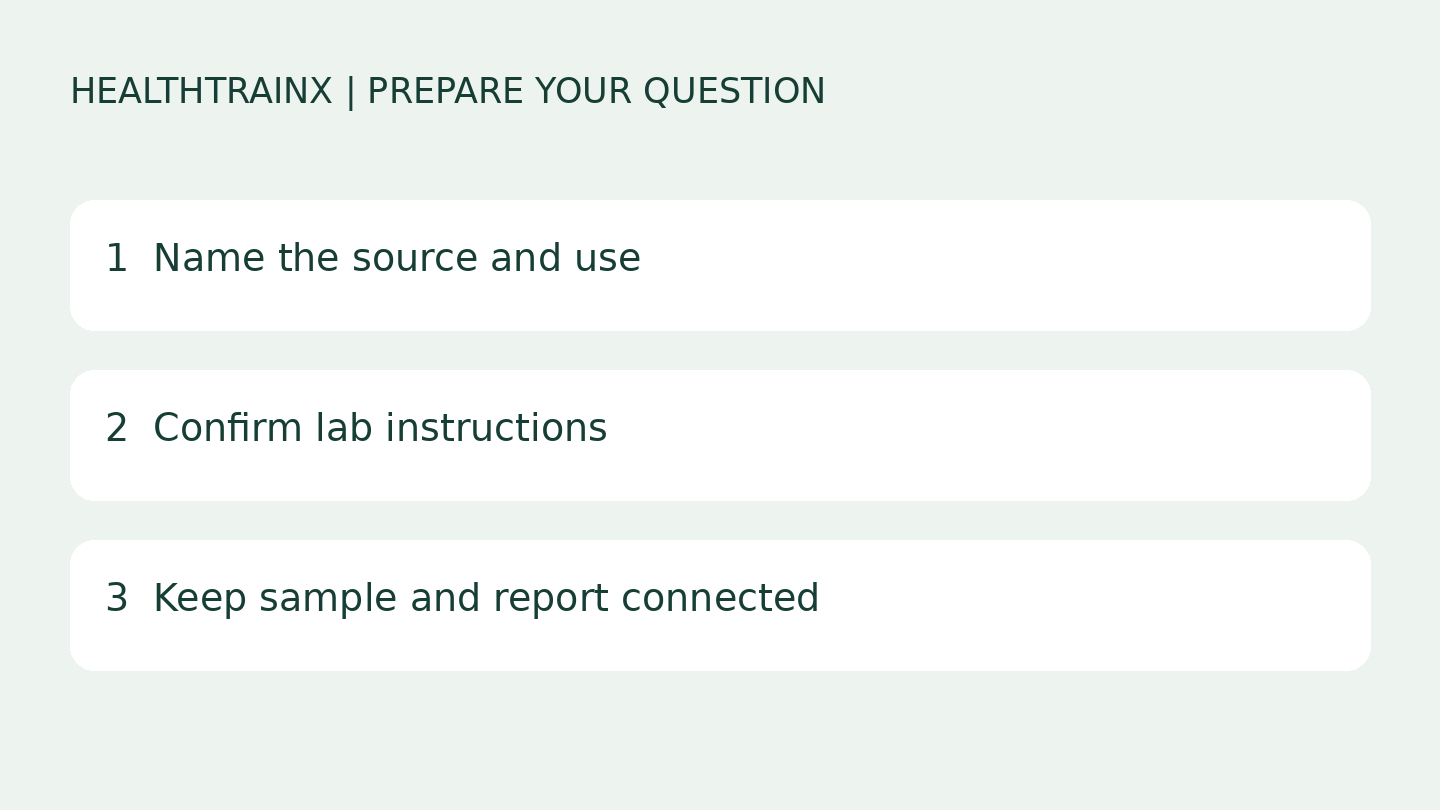
    Preparation sequence: Name the source and use; Confirm lab instructions; Keep sample and report connected.
    Original HealthTrainX preparation worksheet illustration.

    A bottle of water without context leaves a laboratory with unanswered questions. Where did it come from? What will the water be used for? Which question should the test answer? Before collecting a farm sample, write a short brief and ask a qualified local laboratory to confirm the appropriate test and collection procedure.

    Begin with source and intended use

    Create a simple source register: an identifier, the source type, the place it supplies and its intended use. Keep irrigation, produce washing, drinking and other uses distinct. A result obtained for one question should not automatically be treated as an answer to another. If the system blends sources, tell the laboratory rather than describing only the source nearest the sampling point.

    Let the laboratory define the collection method

    University of Minnesota Extension advises contacting the laboratory ahead of collection, using its supplied containers, following its directions and meeting the stated holding time. This is useful preparation guidance. Its page was reviewed in 2018 and contains Minnesota/US context; this article does not adopt its legal thresholds or testing frequency as current rules for South African farms.

    Ask the local laboratory to confirm the sampling location, container, handling, delivery deadline, requested analysis, units and interpretation support. Record the answers before you collect. If a direction is unclear, ask again. Do not improvise a container or preservation method from a photograph in an online article.

    Use an original one-page handoff

    Our preparation worksheet has five fields: source ID; intended use; exact sample point; laboratory instructions and contact; collection and delivery record. After collection, add the sample identifier, date and time, collector and any handling issue. Keep the laboratory report beside this record. These fields organize evidence; they do not certify that a sample was collected correctly.

    For a fictional example, a grower labels two supply points W1 and W2. W1 supplies irrigation and W2 supplies the wash area. The grower sends the register to the laboratory before sampling and asks whether the two purposes require different analyses or procedures. The example illustrates a clearer question, not a claim that either source is safe or unsafe.

    Keep interpretation and action distinct

    When the report arrives, check that its identifier matches your record and ask about any limitation or handling concern. Have a qualified adviser interpret the result for the intended use and applicable local requirements. A single result does not describe every source, season or future condition, and this worksheet does not set treatment instructions.

    Prepare the brief, then contact your local laboratory. Related: the crop-photo checklist helps organize another type of field evidence; consulting preparation and the resource hub help structure your next question.

    Source and scope

    University of Minnesota Extension: Testing well water for fruit and vegetable production (reviewed 2018; checked October 18, 2026). Ask your qualified local laboratory and relevant authority about current requirements for your location and intended use. This article is preparation guidance, not a water-safety certification, legal assessment or treatment recommendation.

    Ask about a crop technology review

  • LiveGood membership: compare the cost against your actual basket

    LiveGood membership: compare the cost against your actual basket

    Skip to content

    LiveGood membership: compare the cost against your actual basket

    By HealthTrainX editorial team · Published October 18, 2026

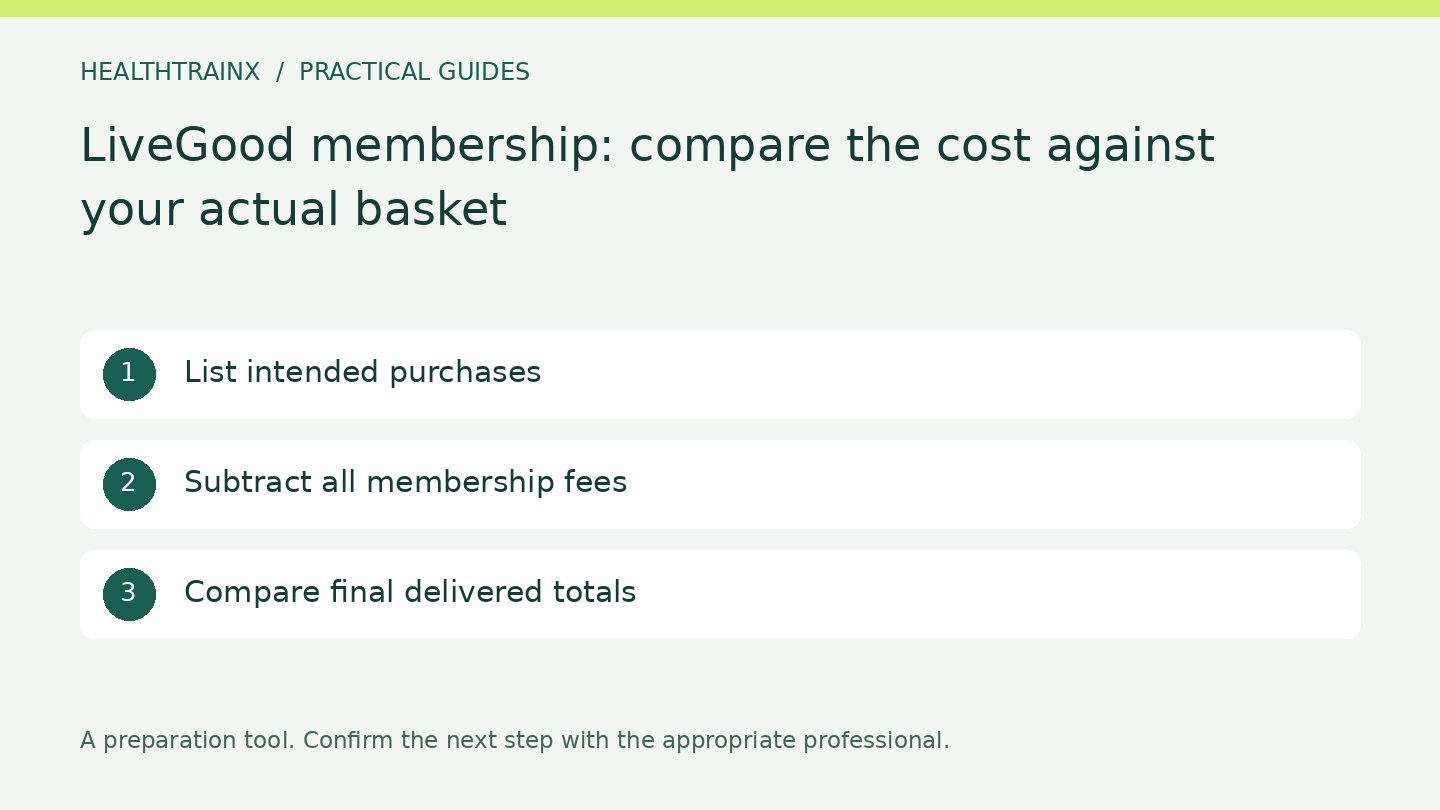
    Checklist: List intended purchases; Subtract all membership fees; Compare final delivered totals.
    Original HealthTrainX checklist illustration.

    A member price is one part of a buying decision. The useful question is whether your planned purchases justify the membership fee after delivery, taxes and any other charges. Buying additional products to create a larger apparent saving can defeat the purpose of the comparison.

    Verified membership information

    LiveGood’s membership and FAQ pages, checked on 18 October 2026, listed membership at US$9.95 per month or US$99.95 per year. The FAQ describes automatic monthly billing and a cancellation route through “My Membership”; it directs annual cancellation questions to support. Recheck the terms presented during enrollment. Do not assume cancellation automatically means a refund.

    Retail buying, paid membership and participating as an affiliate are different choices. A product shopper does not need to evaluate income claims to compare a purchase. This guide makes no earnings projection or recommendation to join a business opportunity.

    A transparent example

    For illustration, suppose the retail and member prices for a planned purchase differ by US$15. This is a hypothetical price difference, not a current Super Greens retail-price quote. The current review verified the membership fees but did not verify a current retail Super Greens price. If a buyer already intended one such purchase during a monthly membership period, subtracting the $9.95 membership fee leaves $5.05 before differences in delivery, tax or other charges. This is illustrative arithmetic, not a guaranteed saving.

    Illustrative membership arithmetic, excluding delivery and taxes
    ScenarioCalculationResult
    No purchases during a paid month$0 product savings − $9.95 fee$9.95 additional cost
    One planned purchase with a $15 price difference$15 − $9.95$5.05 before other charges
    Twelve monthly fees12 × $9.95$119.40
    Annual fee compared with twelve monthly fees$119.40 − $99.95$19.45 fee difference

    Build your own basket comparison

    List only purchases you intended to make, with the same product quantities and destination in both columns. Calculate retail delivered total minus member delivered total, then subtract membership fees for the comparison period. If you already included a fee inside the member total, do not subtract it twice. Mark unavailable charges as unknown until checkout supplies them.

    What the comparison cannot answer

    A lower price does not prove a supplement is appropriate for you, equivalent to a competitor, or supported by the same evidence. Discuss suitability with a qualified health professional. Verify current product labels and the exact return policy; this review does not promise a particular refund window.

    Try the comparison with a real product: our Organic Super Greens buying-options comparison separates retail, paid membership and monthly product subscription, with a direct attributed supplier route. Product-page prices were checked October 25, 2026; confirm the final shipping, tax and renewal terms with LiveGood.

    Use the HealthTrainX partner catalog to reach provider information, and read our terms and disclosures. Affiliate links may earn HealthTrainX a commission. For related buying preparation, visit the resource hub.

    Sources and review date

    Sources checked 18 October 2026. Product prices, availability and provider terms may change; recheck the actual enrollment and checkout terms before buying. Editorial byline: HealthTrainX editorial team. No clinical or veterinary review claimed.
  • How to read a supplement label without turning it into a promise

    How to read a supplement label without turning it into a promise

    Skip to content

    How to read a supplement label without turning it into a promise

    By HealthTrainX editorial team · Published October 18, 2026

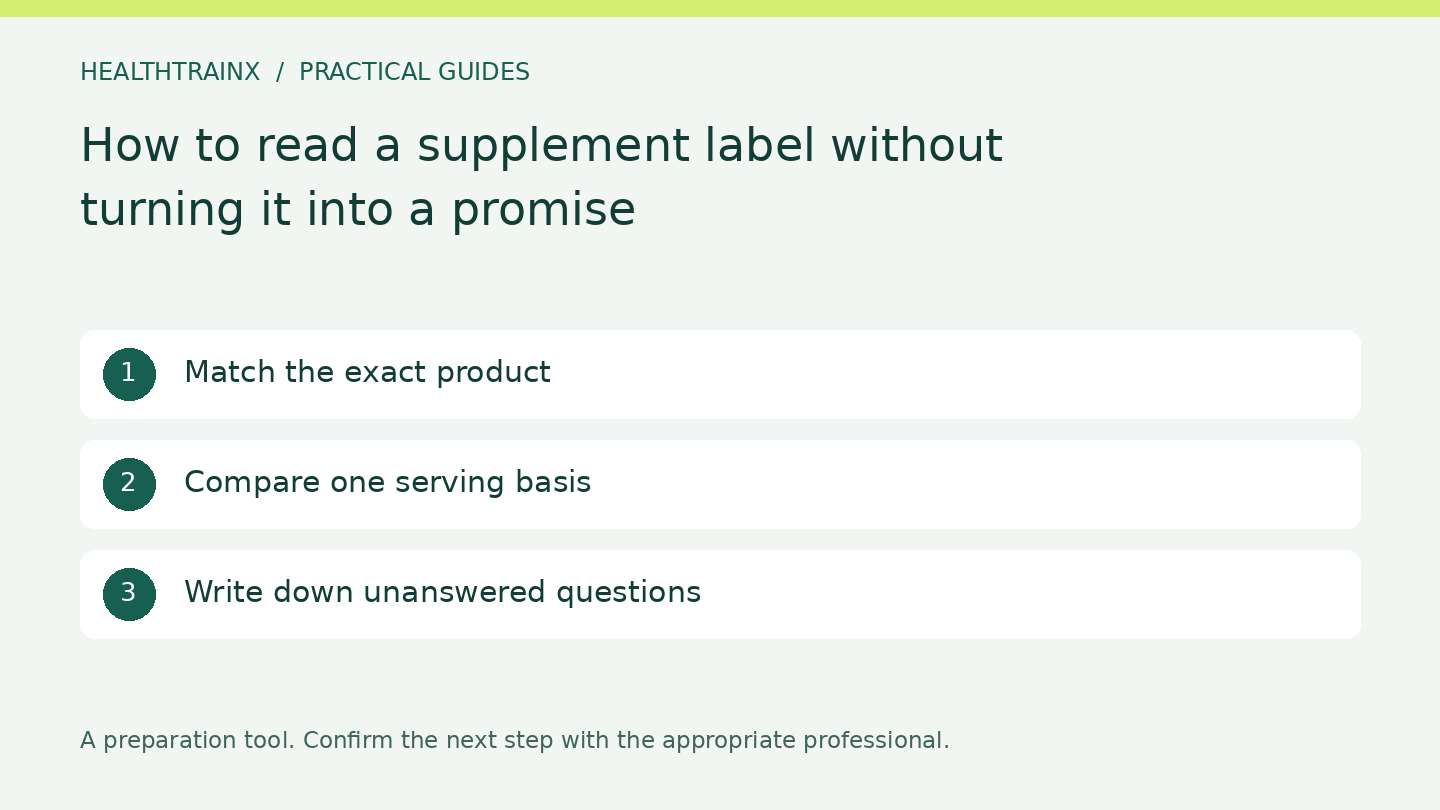
    Checklist: Match the exact product; Compare one serving basis; Write down unanswered questions.
    Original HealthTrainX checklist illustration.

    A supplement label can tell you what a seller says is in a product. It cannot tell you, by itself, whether you need it or whether a benefit claimed online will occur. The most useful first step is to turn the label into a short, consistent record.

    Make sure you are comparing the same thing

    Record the full name, variant, package size and the date you checked it. A photograph in an old post may show a different formulation or pack. Use a readable current label for the product you would actually order. If the retailer and manufacturer show different information, ask them to reconcile it before treating either as settled.

    Start with the serving basis

    FDA explains that Supplement Facts panels identify serving size and quantities per serving; other ingredients appear separately. Serving sizes are chosen by manufacturers rather than standardized across all supplements. Compare the same basis and keep the stated units visible. Do not assume that two scoops, two tablets or two similarly sized bottles provide equivalent quantities.

    A label-reading worksheet
    FieldYour notes
    Exact product and date checked_____
    Serving size and servings per container_____
    Ingredients and quantities as printed_____
    Other ingredients and warnings_____
    Missing or conflicting information_____

    Ready to compare the price as well as the label? Use our total purchase cost worksheet to record the same product, quantity and destination, including delivery and any recurring charges. A lower price does not establish suitability.

    Write the question before choosing the product

    Consider two fictional shopping notes. “This looks more powerful” is hard to assess. “These labels use different serving sizes; can you help me compare them and decide whether either is relevant to my needs?” gives a pharmacist or clinician a specific question. Include other medicines and supplements in that conversation, rather than assessing a new purchase in isolation.

    Keep product identity separate from product claims

    A seal, a testimonial and a nutrient amount answer different questions. Write a marketing claim in its own column and look for the evidence behind that particular claim. If a study concerns a different population, dose or formulation, do not assume it applies to the item in your basket. “More” on a label is not a reason to take more.

    NIH’s Office of Dietary Supplements explains that multivitamin/mineral products vary, and supplements do not replace a varied diet. Use professional advice for suitability; this worksheet is a shopping and information-organizing aid.

    Find provider listings through the partner catalog, where affiliate links may generate commission for HealthTrainX. For a broader question, use the consultation-preparation guide. Related educational material is available in the resource hub.

    Sources and review date

    Sources checked 18 October 2026. Product labels and provider terms may change; verify the current information before purchasing. Editorial byline: HealthTrainX editorial team. No clinical or veterinary review claimed.
  • Compare the whole purchase, not just the price on the card

    Compare the whole purchase, not just the price on the card

    Skip to content

    Compare the whole purchase, not just the price on the card

    By HealthTrainX editorial team · Published October 18, 2026

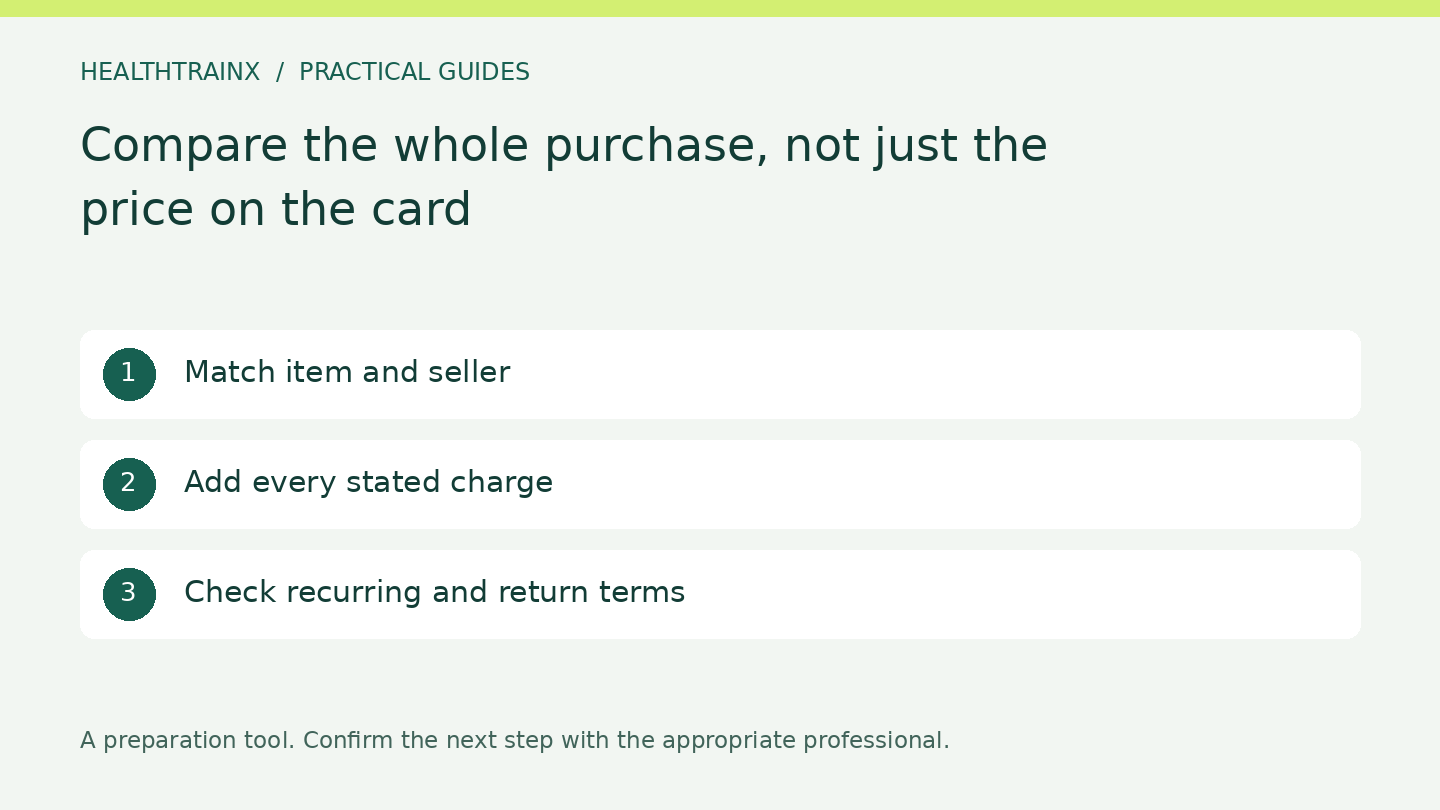
    Checklist: Match item and seller; Add every stated charge; Check recurring and return terms.
    Original HealthTrainX checklist illustration.

    A product card gives you a starting point. The amount you pay—and the support you receive—depends on the seller, shipping destination and checkout terms. A short comparison sheet can help you make a clearer decision before entering payment details.

    Start with the exact item

    Write down the product name, size, flavor or variant and seller. Two similar photographs do not establish that two offers contain the same item. Check the current label and listing rather than relying on a saved screenshot.

    Make the total visible

    Record the item price, taxes shown, delivery charges and any handling fee. For a recurring offer, also note the billing interval and what happens after an introductory price ends. Compare the same destination and quantity so your totals mean something.

    Your comparison worksheet
    QuestionOffer AOffer B
    Exact item and quantity
    Named seller
    Total at checkout
    One-time or recurring?
    Expected shipment and return terms

    Try a worked comparison

    Suppose a fictional offer lists an item at $20 plus $8 delivery, while another lists the same quantity at $25 plus $2 delivery. Before any tax or other charges, the totals are $28 and $27. The lower item price is not the lower delivered price. If one offer also requires membership, add the relevant membership cost before comparing.

    Keep “not shown” separate from zero. Missing delivery information does not mean free delivery. Save the date and currency with each quote, and compare totals again if the destination or quantity changes.

    Consider the cost of changing your mind

    Check whether returns are accepted, who pays return shipping and whether a restocking charge applies. Keep the order confirmation and the terms presented when you purchased. The FTC advises shoppers to compare costs and review delivery and refund details.

    Keep the two buying routes clear

    When a HealthTrainX link takes you to an independent provider, check that provider’s checkout and terms. A referral click alone does not confirm a purchase or membership. Some links are affiliate links, which may generate a commission for HealthTrainX. This guide does not establish that a particular product is suitable for your health needs.

    Explore the HealthTrainX partner catalog, read our terms and disclosures, or ask a question. Return to the homepage.

    Sources and review date

    Source rechecked October 18, 2026. Product prices, availability and provider terms may change. By HealthTrainX editorial team. No clinical or veterinary review claimed.
  • Planning a farm-technology discussion? Send a focused brief

    Planning a farm-technology discussion? Send a focused brief

    Skip to content

    Planning a farm-technology discussion? Send a focused brief

    By HealthTrainX editorial team · Published October 18, 2026

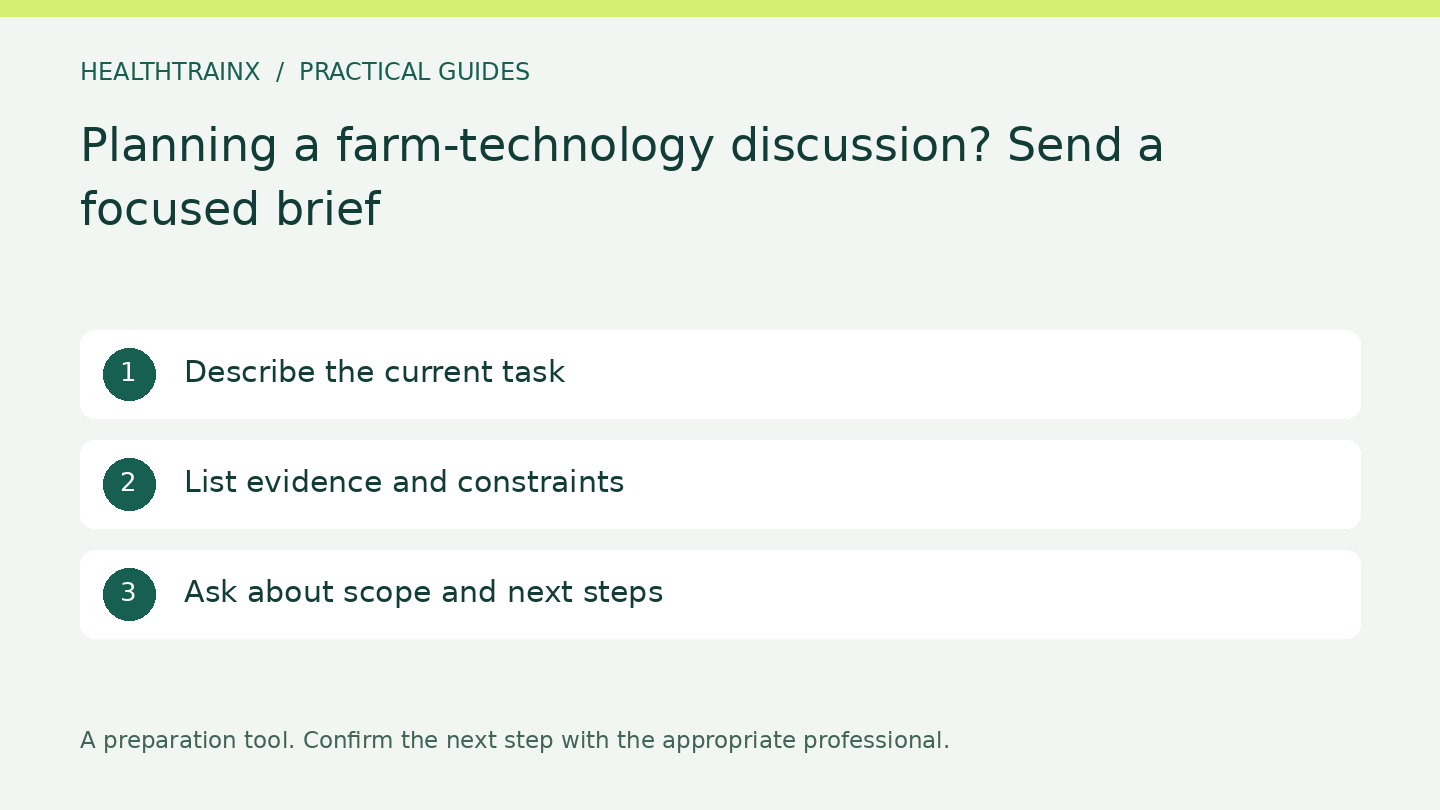
    Checklist: Describe the current task; List evidence and constraints; Ask about scope and next steps.
    Original HealthTrainX checklist illustration.

    If you are considering a farm-technology project, a short brief can make the first conversation more productive. Explain the decision you face and the information you already have. You do not need to select a product or claim a return on investment before asking about a service.

    Describe the task in plain language

    Start with the crop or operating context at a general level, the task you want to improve and the way it is handled today. “We want a more consistent weekly field-observation record” gives a clearer starting point than “We need AI.” Avoid sharing exact coordinates, private staff details or commercially sensitive files in a public comment.

    Use this five-line brief

    1. Setting: the type of operation and the relevant team or task.
    2. Current process: what happens now and where difficulties arise.
    3. Available evidence: examples of records, timings or observations you can share appropriately.
    4. Constraints: connectivity, skills, budget range or timing, if you choose to disclose them.
    5. Question: what you want help clarifying before deciding on a next step.

    Make the first request specific

    A fictional example: “We record crop observations in several separate files and want to understand options for a consistent weekly summary. We can provide a redacted sample and an outline of the current process. Could you confirm whether this question fits your service scope, who would respond, and any initial fees?” This is a preparation example, not a description of a completed HealthTrainX engagement.

    Agree on scope before discussing outcomes

    Ask what the proposed service includes, who will provide it, which expertise is relevant, and what deliverable you would receive. Confirm availability, format, timing, fees and data-handling arrangements directly. A website inquiry is not a booking confirmation, a quotation or a guarantee that a particular specialist is available.

    If a project moves toward testing an agricultural outcome, its design matters. SARE’s research guidance provides a starting point for thinking about comparisons and experimental design. A consultation or small pilot cannot promise a yield increase, earlier disease detection or a commercial return.

    Send a brief, then confirm the next step

    Use Contact HealthTrainX to ask about the fit and scope of your inquiry. Check the current contact details on that page; do not send confidential attachments until the recipient and an appropriate channel are confirmed. The crop and agriculture consulting page describes the inquiry route.

    Related: read how to prepare for a consulting conversation and the crop-photo checklist if your question includes visible plant observations.

    Sources and review date

    Sources rechecked October 18, 2026. By HealthTrainX editorial team. No independent product-efficacy review claimed.
  • Before changing crop nutrients, organize the soil-test question

    Before changing crop nutrients, organize the soil-test question

    Skip to content

    Before changing crop nutrients, organize the soil-test question

    By HealthTrainX editorial team · Published October 17, 2026

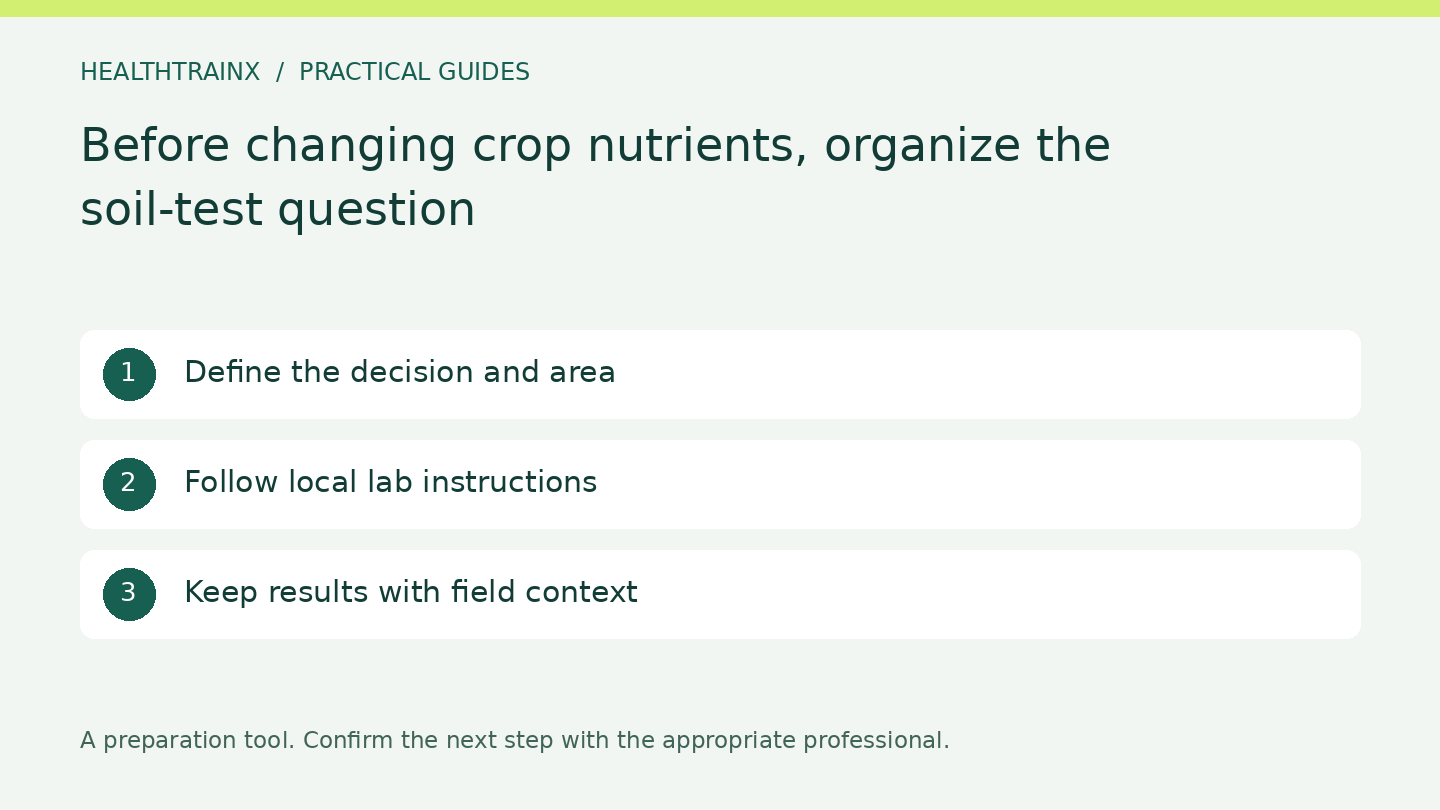
    Checklist: Define the decision and area; Follow local lab instructions; Keep results with field context.
    Original HealthTrainX checklist illustration.

    Uneven plant growth can make a quick product recommendation tempting. A more useful first question is what evidence would help assess the situation. Soil testing may contribute information about the sampled soil, but it does not, by itself, explain every visible plant problem.

    Define the decision before collecting a sample

    Write down what you are trying to decide: for example, how to discuss a nutrient-management plan with an adviser. Identify the field, bed or management area using a consistent label. Keep areas with meaningfully different histories separate in your notes, and ask the laboratory whether they require separate samples.

    Ask the laboratory for its procedure

    Sampling depth, number of subsamples, containers and timing can depend on the test and setting. Use the chosen laboratory’s instructions rather than copying a generic depth from a post. Ask how to avoid contamination, what information must accompany the sample and which tests answer your question. If you already collected a sample differently, disclose that before relying on the result.

    Record context alongside the result

    University of Minnesota Extension describes soil tests as useful for information such as pH and selected nutrients, with recommendations tied to the intended use. Its regional advice should not be treated as a universal prescription. Ask a local adviser to interpret the laboratory’s units, methods and recommendations for your crop and location.

    A sample record to keep
    RecordWhy it helps
    Area label and collection dateConnects the result to the sampled place and time
    Laboratory procedure followedDocuments how the sample was prepared
    Crop and confirmed recent operationsProvides context for interpretation
    Result, units and open questionsKeeps the report distinct from your assumptions

    Avoid turning a single number into a treatment claim

    A report is not proof that a particular product will solve a problem or increase yield. If an adviser recommends an action, record the rationale and any follow-up observations requested. Where symptoms need separate assessment, use suitable photographs and ask whether plant diagnostic testing is also relevant.

    Begin with our crop-photo checklist for visual observations. For questions about service scope, visit crop and agriculture consulting or contact HealthTrainX. Bring your local laboratory report to the appropriate adviser instead of applying a generic online nutrient rate.

    Sources and review date

    Ask about a crop technology review

    Share a brief question without exact farm coordinates or confidential records. Any paid work requires an agreed scope and confirmed quotation. A technology review does not replace local laboratory or qualified agronomic advice.

    Sources rechecked October 17, 2026. By HealthTrainX editorial team. No independent product-efficacy review claimed.
  • Before you act on an AI health answer, check the source trail

    Before you act on an AI health answer, check the source trail

    Skip to content

    Before you act on an AI health answer, check the source trail

    By HealthTrainX editorial team · Published October 17, 2026

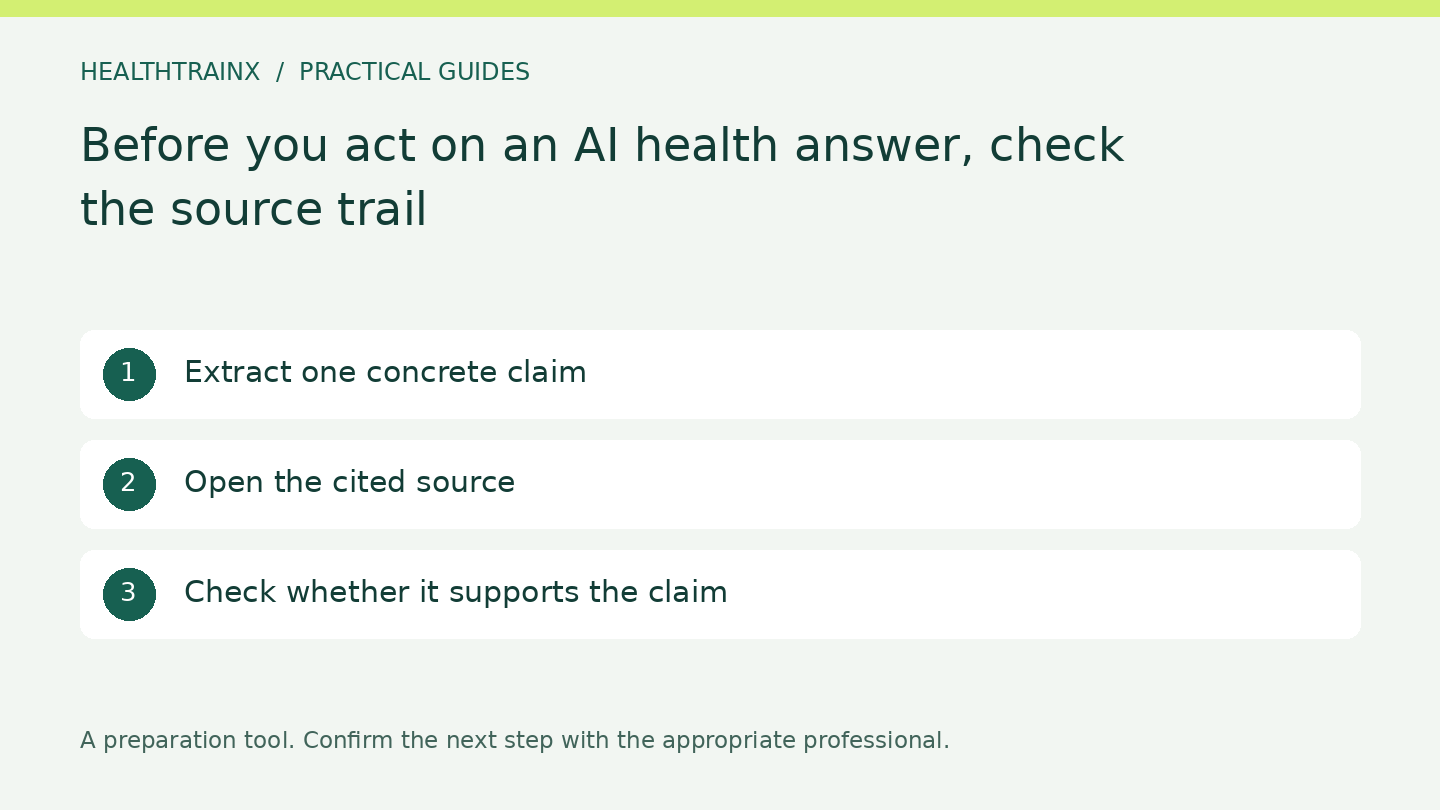
    Checklist: Extract one concrete claim; Open the cited source; Check whether it supports the claim.
    Original HealthTrainX checklist illustration.

    An AI answer can sound precise even when its source does not support the conclusion. Treat the answer as a starting point for checking information, rather than as an independent authority. You can make that check manageable by choosing one concrete claim at a time.

    Turn a broad answer into checkable statements

    For example, “this tool improves wellness” is too broad to evaluate. Ask what outcome, in which people, over what period, and compared with what. Write the answer’s exact claim in your notes, then record the source offered for it. If there is no source, label the claim “unsupported in this answer,” rather than filling in a convincing-looking citation yourself.

    Open the source, not just the link label

    Check that the link leads to the named organization or paper. Read the relevant passage and enough surrounding context to understand its limits. A source about a different product, population or setting may be useful background without establishing the claim you are checking. Record whether the statement is directly supported, only partly supported, or an inference.

    A short source-trace record
    FieldNote
    Claim and source URL_____
    What the source actually supports_____
    Population, setting and date_____
    Unresolved question for a professional_____

    Use both credibility and relevance

    MedlinePlus’s evaluation guidance asks readers to consider the provider, purpose, evidence and currency of health information. A reputable source can still be irrelevant to a particular question. Check both the organization and the fit between its evidence and the claim.

    WHO’s guidance on large multimodal models highlights risks including inaccurate and incomplete health responses. Adding citations to an answer does not remove the need to check them. Do not change treatment or delay care because an AI response appears confident.

    Keep your next step small and useful

    Save two or three unresolved questions for your clinician or pharmacist. You do not need to paste private medical records into a public AI tool or a website comment to ask for a source. A fictional question might be: “Does this source apply to my situation, or does it concern a different group?”

    Use the HealthTrainX preparation guide to organize an inquiry. Confirm the scope of human wellness consulting before proceeding. Related educational guides are available in the resource hub.

    Sources and review date

    Ask about a digital-health workflow review

    Do not submit private medical records in a general inquiry. Any paid work requires an agreed scope and confirmed quotation; HealthTrainX inquiries are not a clinical or emergency service.

    Sources rechecked October 17, 2026. By HealthTrainX editorial team. No clinical or veterinary review claimed.