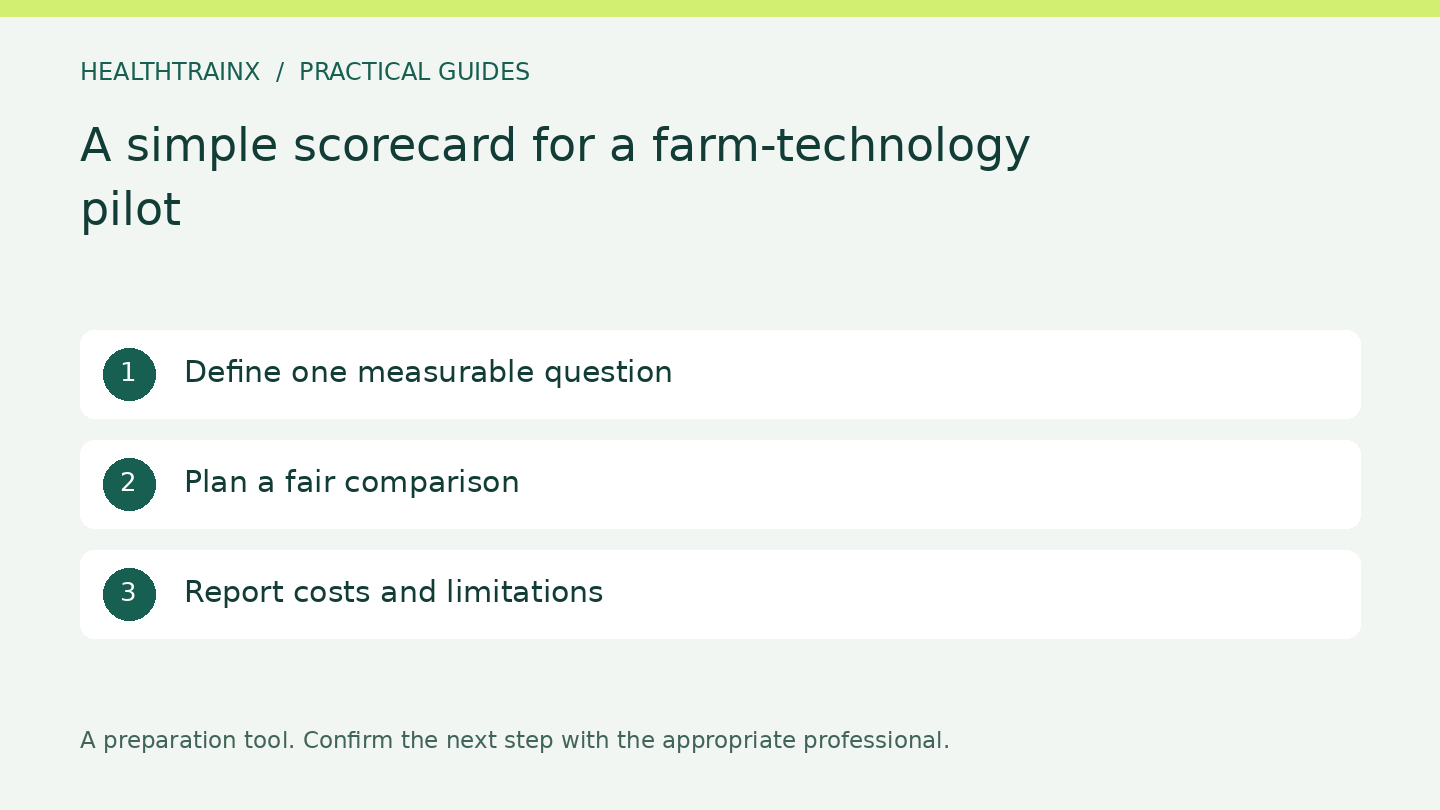
A simple scorecard for a farm-technology pilot
By HealthTrainX editorial team · Published October 17, 2026

A demonstration can show that a tool operates. A useful pilot asks whether it helps with a defined task in your setting, at an acceptable cost and with manageable limitations. Write that question before collecting results so that an attractive example does not become the entire evaluation.
Choose a narrow operational question
For example: “Can this recordkeeping tool reduce the time needed to assemble our weekly field notes without losing required information?” That is easier to evaluate than “Does this technology transform the farm?” Specify who will use the tool, which task is included and what remains outside the test.
Record the starting point
Measure the existing process using the same units you plan to use later. Include setup time, training, corrections and periods when the tool is unavailable. A faster screen interaction may not reduce the total time needed to produce a usable record. Keep both the raw notes and any summary calculations.
Design the comparison before interpreting it
SARE’s on-farm research guidance explains why controls, replication and randomization matter for field experiments. The right design depends on the question and practical constraints. For crop-response or yield questions, ask an appropriate adviser to help design the comparison; a single treated strip or before-and-after photograph cannot establish causation.
| Measure | Baseline | Pilot result |
|---|---|---|
| Time for the complete task | _____ | _____ |
| Missing records or corrections | _____ | _____ |
| Setup, training and recurring costs | _____ | _____ |
| Failures and extra support required | _____ | _____ |
Define a decision rule
Agree in advance what would justify expanding, changing or stopping the pilot. Use criteria tied to the task, not a vendor’s general claim. A fictional recordkeeping test might require complete records, acceptable correction time and a total cost the team can sustain. Choose your own thresholds; the example is not an industry benchmark.
Report the limits with the outcome
Describe the setting, dates, comparison method and missing data. A positive result on one farm does not establish performance on another. Avoid experiments that alter animal treatment or health care without the relevant professionals. Distinguish a technology demonstration from a validated agricultural or veterinary claim.
Use the consultation-preparation guide to frame a request. For an agricultural discussion, confirm the scope of HealthTrainX crop consulting. Related preparation tools are in the resource hub.
Sources and review date
Request a Crop Technology Review
An inquiry is not a booking or a promise of results. Any paid work requires a written scope and confirmed availability.